
Every business relies on data. The facts and figures are what keep everything moving. You use them to support your budget decision, streamline your processes, fill any potential gaps – anything and everything. Yet for as important as it is, it’s not always given the attention it needs.
This often creates data ‘silos’ – groups of information that are isolated from the wider organisation. It might be accounts departments with raw financial data, sales departments with sales figures, or proof of audits and safety checks. Not everyone who needs access to that data can do so, and it leads to multiple inaccurate versions of the data.
Countless offline spreadsheets shared haphazardly through email are only going to confuse matters. And trying to chase up any missing data is time-consuming; pointless admin wastes a third of an office worker’s day. So how can you avoid this happening in the first place?
Consolidate information in one location
If you face a similar problem, the first step is to organise your data in one centralised location. This might be the biggest part of any change you have to do. It will require you to transfer over all the information you currently have. But once you do, you’ll see how much easier it is to log changes.
Anytime someone has something new to add, it goes into one solution that’s then up-to-date for everyone else with access. You can also make sure it’s secure and should be able to adjust permissions when someone leaves the company.
You’ll likely find that such a solution is cloud-based, which has the added benefit of being accessible almost anywhere. Preferably, you want something that can be tailored to you and your team, too. Not everyone will need access to every piece of information. For example, audit data might only be needed by managers and the relevant teams.
Change your culture around sharing data
Now you have your solution in place, you need to shift your culture when it comes to logging and sharing information. After all, everything can only stay up-to-date if people are adding to the data.
This is going to be essential if you have multiple sites that have their own series of checks and measures. Say you run a chain of retail stores that need specific fire-safety checks. You want oversight that these have been completed on time and to acceptable standards. By encouraging your people to share this information, you create an easily accessible paper trail showing what was completed and when.
Introduce consistent processes
Part of this is going to be a consistent approach to data collection. Because when you can do that, it makes actually looking at the data that much easier. It simplifies the process, freeing up that time that used to be spent on chasing information for analysis and action.
And decision-makers with clear access to the data they need can go on to make the best decisions and changes before small niggles have a chance to become a problem. So make sure people stay consistent. Everyone should know what information is their responsibility. If they’re absent, who covers them? What time should information be uploaded? These are questions to figure out.
What you’ll find when you take these steps is that data silos become a thing of the past. Gaps in information, if they even exist, should be much easier to find and fill. And you have much more time on your hands to actually get your job done. Data silos don’t have to be an unavoidable part of your work anymore.
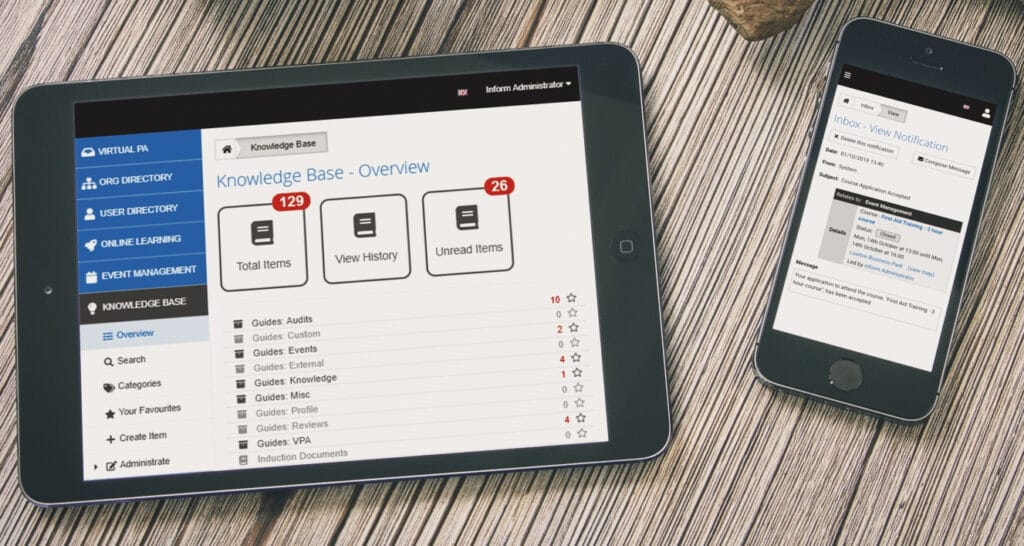
For one platform that lets you do all of this, look to Inform People. Our Knowledge Base allows you to store documents securely, while Insights give you a complete view of your business. To find out more about our features and get in touch via email or on +44 (0)161 713 4104.