
There’s been debate amongst clinical teams for years around lowering the threshold of the FIT tests that form the backbone of the Bowel Cancer Screening (BCS) programme, and on the 26th January 2026 the NHS published the below article setting out new guidelines:
Capacity and Demand Modelling with THRIVE: Bowel Cancer Screening
If this isn’t your area of expertise, let us explore a little further. FIT is the name for home testing kits that help to identify patients at higher risk of having bowel cancer. This programme has been highly successful in helping to catch bowel cancer early and most importantly at more treatable stages. By identifying bowel cancer early, a patient’s outlook for recovery is significantly increased and the cost to the NHS is significantly decreased.
With this success in mind, it has been announced that the testing threshold for those asked to attend a hospital-based bowel cancer screening will be set at a significantly lower result. Therefore leading to the NHS expecting to offer additional screening colonoscopies totalling about 35% more on top of those currently conducted.
The positive impacts of this will be that more patients who have cancer will catch it in the early stages and before it has a chance to worsen: an outcome that will certainly see lives saved.
It does, however, raise some difficult issues regarding capacity of the standard Endoscopy unit. As of November 2025 (the most recent data available at the time of writing) there were:
- 122 providers with DMO1 Colonoscopy 6 Week Wait lists of over 5%
- 110 providers with DMO1 Flexi Sigmoidoscopy 6WW lists of over 5%
- 125 providers with DMO1 Gastroscopy 6WW lists of over 5%
These are the three core procedures performed on most Endoscopy units nationwide. This suggests that many providers are already working at full capacity to reduce their waiting lists to acceptable levels and still struggling – before an additional set of brand new patients is added onto their caseloads.
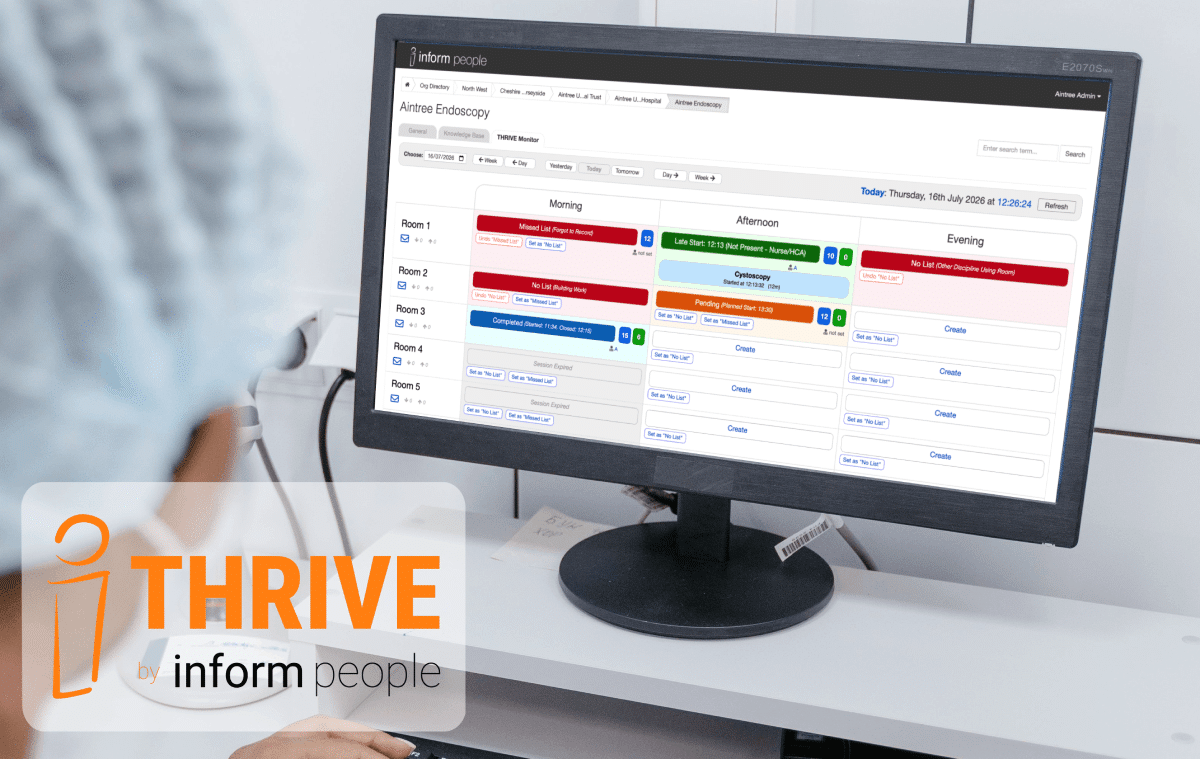
THRIVE captures a lot of information on BCS lists and differentiates them from standard Endoscopy lists or any other niche list types and this gives us an excellent insight into the additional caseload capacity most providers can actually expect to see as a result of these changes.
During 2025, THRIVE providers saw a total of 13,220 Bowel Cancer Screening procedures performed, roughly accounting for 5% of all procedures. This is across 3 full Endoscopy networks and over 35 individual units. In terms of actual lists THRIVE captured information on 4,246 BCS lists with a total of 15,189 procedures, proving that many BCS lists will also have a small amount of capacity for some other basic Endoscopy procedure.
An increase of 35% on these figures would imply that hospitals (and this is just the ones using THRIVE that we have the data for) would be expected to accommodate approximately 4,500 additional procedures. These would need to be performed on roughly 1,500 lists across just three networks in a single year. Extrapolate that to the whole of the UK and the capacity concerns only grow.
On a positive note, the information captured on these BCS lists by THRIVE shows good utilisation of available sessions and an average planned points of 11.13, eclipsing the overall average planned points average of 9.9.
However, a standard Bowel Cancer Screening procedure is allocated three points* within most Endoscopy units, meaning a fully planned list will likely never have more than 4 procedures on it. The BCS programme does have an excellent cancellation rate, meaning unused slots are kept to a minimum, but when a patient does unexpectedly cancel the impacts are significant due to the planned length of a single procedure (around an hour).
Additionally, in the additional non-procedure time that comes with a BCS must be factored in. Most units performing BCS procedures operate an in depth screening process and additional preparation before the patient even arrives on the unit.
Units may be forced to juggle these BCS lists with their standard service lists. When an ordinary service list can often see 10 gastroscopies it can sometimes become difficult to justify planning just 4 procedures onto a list for a provider with a significant gastroscopy waiting list.
Utilisation of space and resources is once again going to become a major focus point for enabling providers to perform the additional 35% they are going to be asked to.
For an example 5 room unit on THRIVE this is the equivalent of asking them to perform 1-2 more BCS lists every single week. Some sites will be able to find this capacity using space not previously available to them such as by moving to 7 day service or utilising evening sessions (though this will require more funding to achieve). Other sites may struggle even more, especially if already running a 7 day service with evening lists finding the space for more lists every single week could prove difficult without additional rooms and staffing.
Some providers have already begun to use THRIVE to calculate what additional resources and funding they are going to require to achieve their requested extra screenings. By using THRIVE data to understand their current performance, they are focused on understanding the variation between weekly throughput and determining what 35% more BCS procedures will look like for them on an individual basis and what resource is going to be needed to handle the jump in patients coming through their doors.
If you are a THRIVE user and would like support in understanding your current Bowel Cancer Screening performance and how a potential jump in demand might look then please contact us at support@informpeople.com
* A point roughly translates to 20 minutes of time and is a metric used within Endoscopy across the UK.